


On the political agenda at last: The circular economy delivers energy sovereignty and security!
Werner & Mertz with Frosch brand on the way to petroleum independence for 40 years
A Mainz company shows that recyclable products are not only ecologically reasonable, but also more relevant than ever to economic policy and national security. With its sustainable approach, the eco pioneer Werner & Mertz provides a positive example in ZDF heute Nachrichten – and focuses on the issue with its own event featuring leading experts on security policy and energy sovereignty.
Independence from fossil resources has become a hot topic
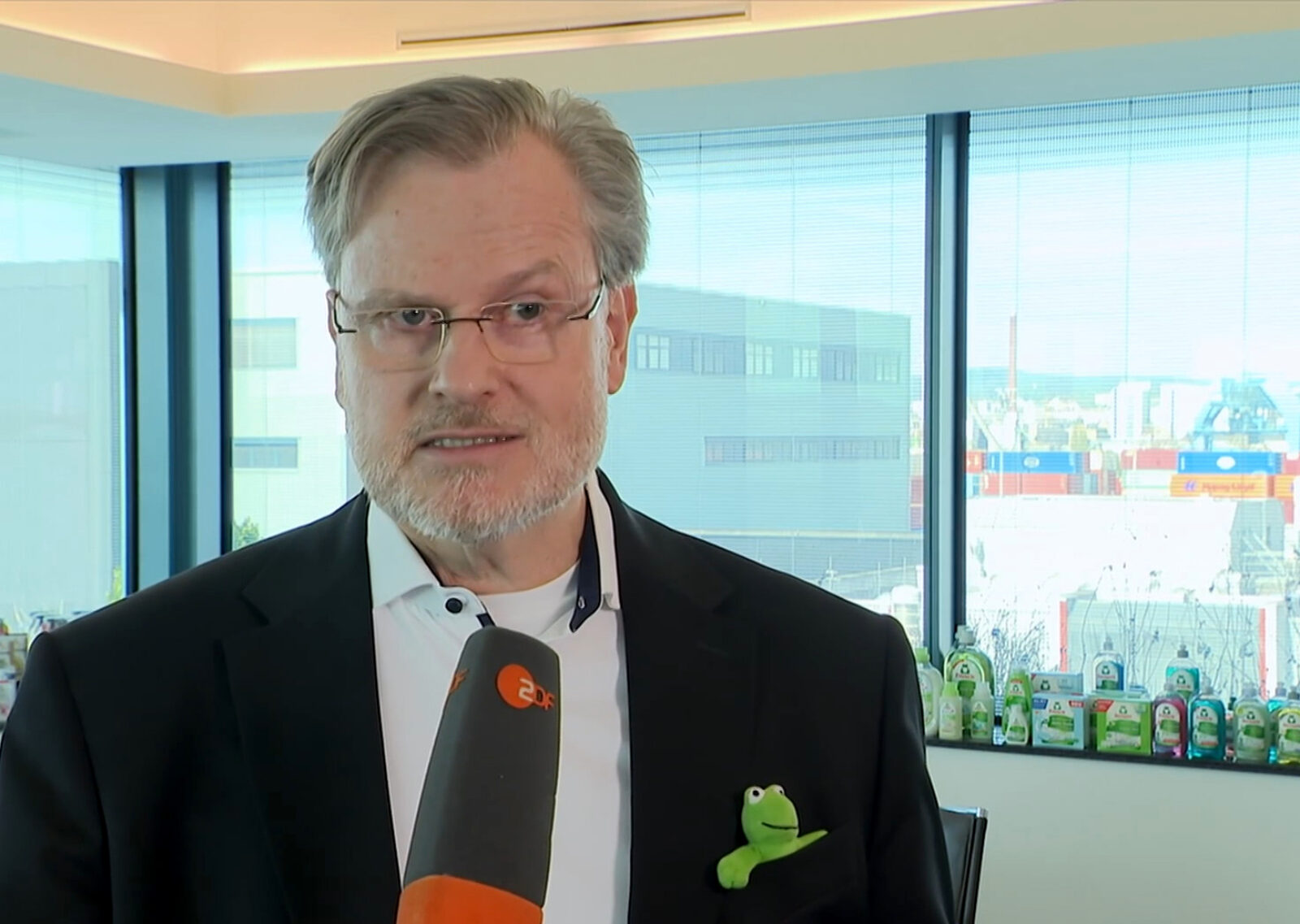
Germany is facing the challenges of rising energy and raw material prices, fragile supply chains and new threats to national security. Attention is turning to issues that have not made it onto the political agenda for some time. They include the transition to renewable energies and the circular economy as a model for the future. All at once they are no longer perceived as strictly “green” environmental issues, but rather as the strategic foundation for safeguarding national security and economic independence. A news item in the ZDF heute Nachrichten on 16 April (Betriebe: Erneuerbare statt fossiler Energien) reported on two Rhineland-Palatinate companies that have successfully transformed their business models, one of which is the cleaning products manufacturer Werner & Mertz with its Frosch brand.
Taking a page from Nature, Frosch has established effective cycles since its founding in 1986. The brand relies on plant-based ingredients and renewable resources and does without petroleum. Packaging too is sustainable. The bottles are made of used plastic with increasingly more material obtained from the Yellow Bag. To date, the company has put more than one billion bottles of 100 percent used plastic on the market—a milestone! This year the brand celebrates its 40th birthday.
During the current crisis, the company benefits from following this path to independence from fossil sources. “Of course we are subject to the mixed costs calculations of our suppliers, who have higher expenses for our plant-based raw materials too. But the effect for us is significantly smaller. This shows that when a company makes a timely switch to renewable raw materials, plant-based ingredients and recycling, it does not suffer as much from price shock,” says Werner & Mertz owner Reinhard Schneider.
Professor Klaus Helling, sustainability expert at Umwelt-Campus Birkenfeld, said in the same ZDF broadcast: “As a matter of fact, we are in a good position as far as the energy transformation and circular economy are concerned. However, we have to make it more widespread and the government has to create the conditions for that to happen.”
Talk with security policy expert Roderich Kiesewetter
What those conditions are and what has to be done to make society, the economy and democratic structures crisis-proof for the future will be taken up by Schneider, CDU politician Roderich Kiesewetter and climate expert Dr. Kira Vinke in the next edition of the talk show Die Zuversichtlichen on 19 May in Berlin.
Kiesewetter, a politician and security policy expert, is also the author of the book Was wollen wir? Was können wir? Deutschlands Rolle in der globalen Machtverschiebung. Vinke is Head of the Center for Climate and Foreign Policy at the German Council on Foreign Relations (DGAP). They will talk with Schneider about how Germany can boost its power to act in an increasingly unstable world. The discussion goes beyond defense and crisis management capabilities to include components of sustainability, the role of the circular economy, and the country’s ability to shape changes actively.
The talk show entitled Die Zuversichtlichen was first produced in 2023. In the one-hour panel discussions, experts describe and analyze current challenges and lend encouragement to the audience with their proposals for feasible, reasonable solutions.
One of the most vital is the circular economy. When the format was launched, ecological aspects were in the focus. In times of growing problematic raw material dependencies and related threats, building resilience has taken center stage.
The talk with Kiesewetter, Vinke and Schneider will be aired live at 6 p.m. on 19 May: Die Zuversichtlichen