

We don’t need petroleum for quality!
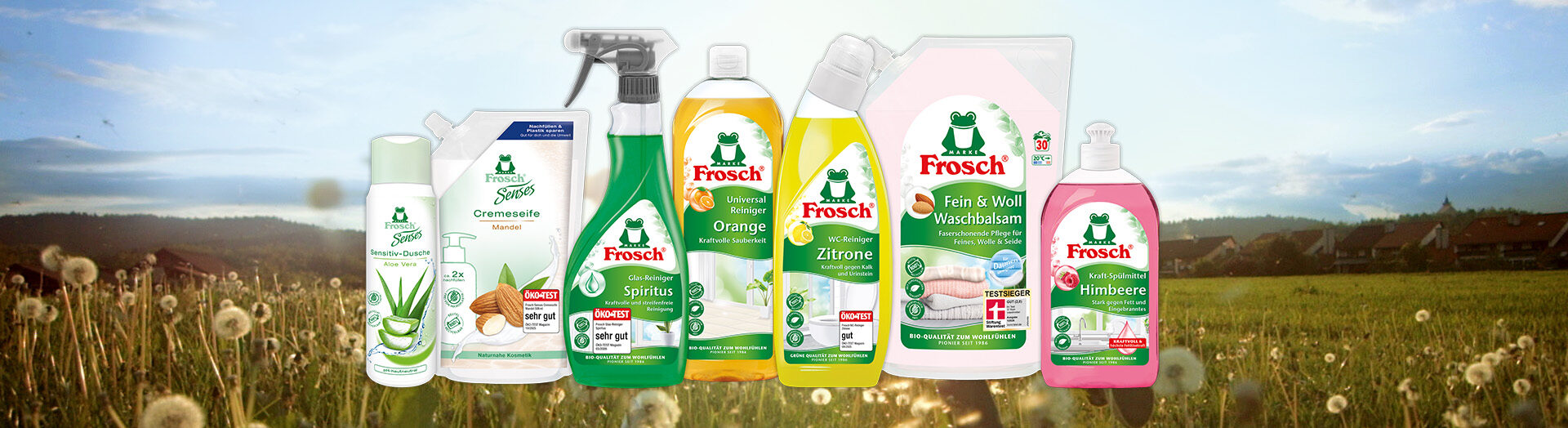
As pioneer for the circular economy, Werner & Mertz with its trusted Frosch brand have been on the way to petroleum independence for the past 40 years. We’ve learned high-performance concepts from Nature and put them into practice in user-friendly cleaning products. Our plant-based ingredients come increasingly from cultivation in Europe. The Frosch brand now offers more than 80 products, from washing and cleaning to personal care with Frosch Senses soaps and shower gels. Varied, high performance products in tune with Nature—completely in line with natural cycles and as independent from fossil fuel sources as possible.

Bottles made from 100% used plastic
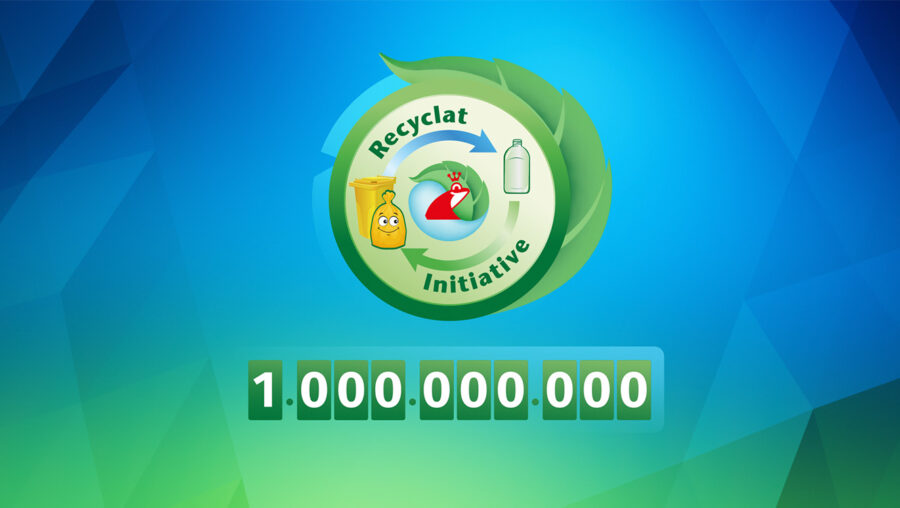
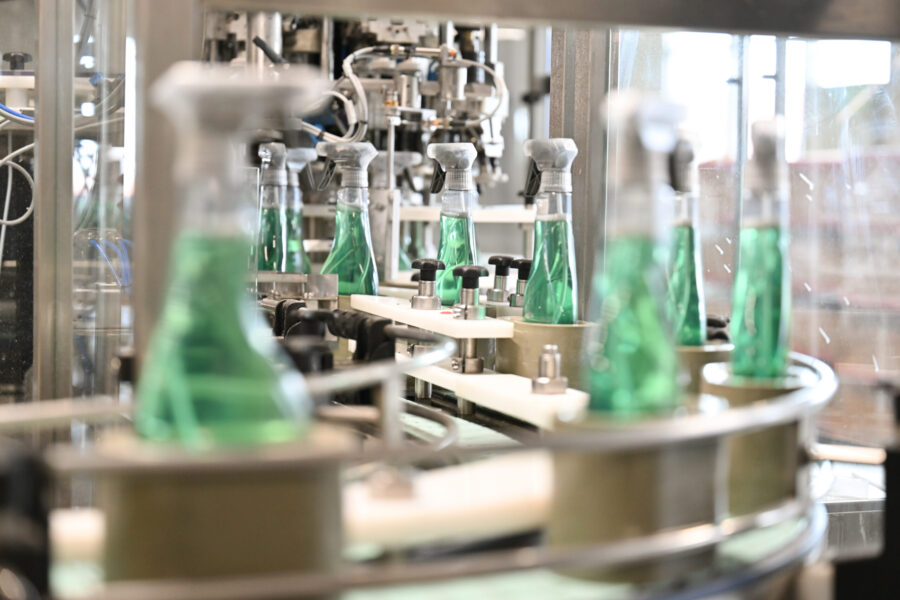
Our efforts to eliminate the use of petroleum focus on packaging. Since the establishment of the Recyclate Initiative in 2012, we have practiced and promoted effective recycling of plastic obtained from household waste collections. Our PET bottles for the Frosch brand are now made from 100 percent used plastic from the Yellow Bag. By the summer of 2025, we had put more than one billion bottles of recycled plastic on the market and thus reached a milestone for a true circular economy.
Cosmetic-grade HDPE bottles for Frosch and HDPE bottles for emsal floor care products and Green Care Professional cleaners also are made of 100 percent recycled plastic from the Yellow Bag.
Integrally sustainable
We continue developing our diverse, high-performance products with plant-based formulations in the interest of a circular economy. Conventional cleaning products with fossil-based surfactants depend often on petroleum and natural gas. In contrast, sustainable cleaning products require surfactants made from regenerative raw materials that come from renewable plant-based sources. Werner & Mertz is also committed continuously increasing the share of surfactants based on European vegetable oil-producting plants such as rapeseed, olive, flax and sunflowers.
Our integrally sustainable view encompasses all elements of a product, i.e., formulation, packaging and production. With the continuous development of our formulations in pursuit of a functioning circular economy and the continuous improvement of our production facilities, we have decreased the use of natural gas in our Mainz factory year after year. This has enabled us to reduce or even eliminate the use of process steam in many of our formulations. Consequently, we require much less per bottle than before. We report our progress transparently in our annual Environmental Statement.
Our exemplary vinegar cleaner
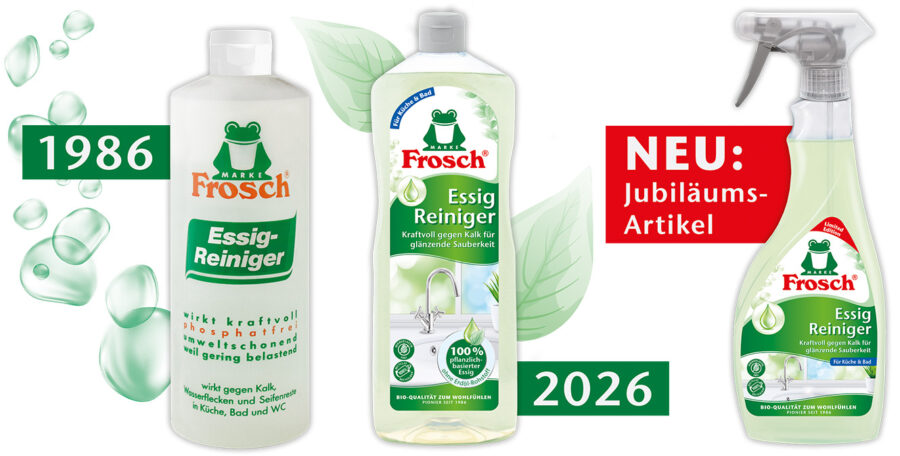
A product that exemplifies our daily activities is our vinegar cleaner. It stands for our intention of combining high-performance cleaning with innovative, sustainable sources of raw materials and thereby pursue new ways far removed from petroleum.
A core component of its effectiveness is acetic acid which comes from wood scraps obtained from local sustainably managed forests. This by-product of pulp production shows how existing material flows from renewable sources can be put to good use and incorporated in functional products—in the practical implementation of the circular economy. The bottles of the vinegar cleaner too are made of 100 percent used plastic from the Yellow Bag. We avoid CO₂ emissions in two ways (link: Virgin Plastic more environmentally damaging than previously assumed? ). One: plastic can be recycled for high-quality use instead of being incinerated and two: our packaging eliminates the need for climate-damaging production of virgin plastic. We thus avoid using petroleum and natural gas in the manufacturing and production process.
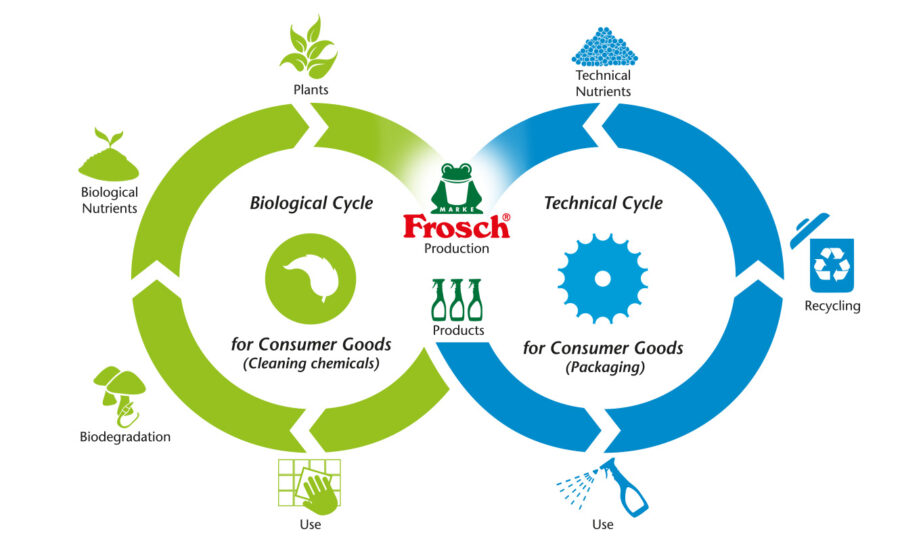
The Frosch vinegar cleaner unites the central principles we stand for:
- the use of plant-based raw materials from regional sources as an alternative to petrochemical sources
- the use of by-products such as wood scraps in the production of high-quality ingredients
- reliably high cleaning performance in everyday use
- packaging solutions made with recycled plastic and designed for subsequent recycling as a contribution to plastic recycling
Key to genuine resource independence
Europe is facing great challenges caused by rising prices for energy and raw materials, unstable supply chains and new threats. It is easy to see that recyclable products are not only good for the environment, but are important for economic and national security reasons as well. The connection is apparent: When we recycle resources here and use them again, we don’t have to import them. Especially in times of crises, that’s an important factor for a resilient economy. Because the circular economy makes us less dependent on international supply chains, our energy sovereignty is stronger. That’s why the circular economy is such a fundamental element in the security and economic policies of Germany and Europe.
Werner & Mertz as Best Practice
The milestones we have achieved prove that the circular economy works in practice. With scalable solutions, we create real Best Practice examples that provide orientation and put the transformation within reach.
Media reports in the ZDF heute-Nachrichten, SWR and Tagesschau.de have designated us a circular economy pioneer.
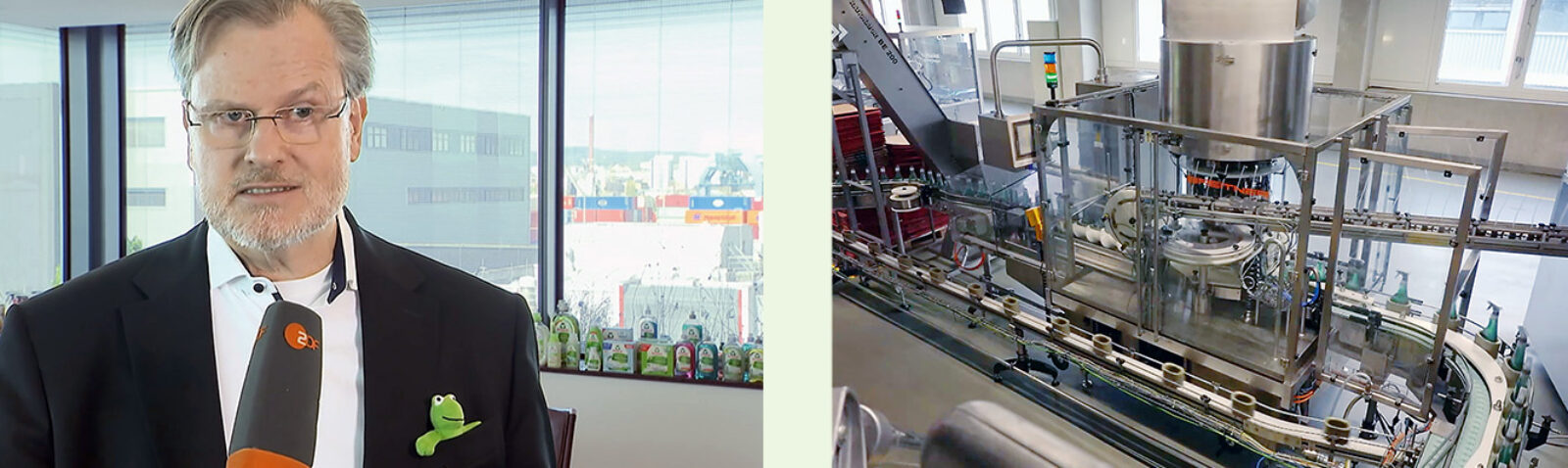
We actively seek and establish strong partnerships. We are convinced that the transformation to a resource-conserving economy can be made only in close cooperation with players from the environmental, scientific and societal areas. In this case we see ourselves as a “Lobby for Good”. We use our voice to call attention to ecological innovations, to further develop favorable political conditions and to make measurable progress.
In all of this work, NABU (Nature And Biodiversity Conservation Union) is an important partner. Each of us has brought our own perspective to our decades-long cooperation as we pursue common goals, i.e., to promote biodiversity and widespread use of the circular economy and to encourage sustainable solutions along the entire value chain.
Together with NABU and our cooperation partners in the Recyclate Initiative, we share our ideas on increasing high-quality recycling streams with politicians and decision makers and urge them to develop the required political frameworks in Germany and the EU.
Among other things, we want to play a part in setting the agenda in order to establish the circular economy as a central element of sustainable business practices.
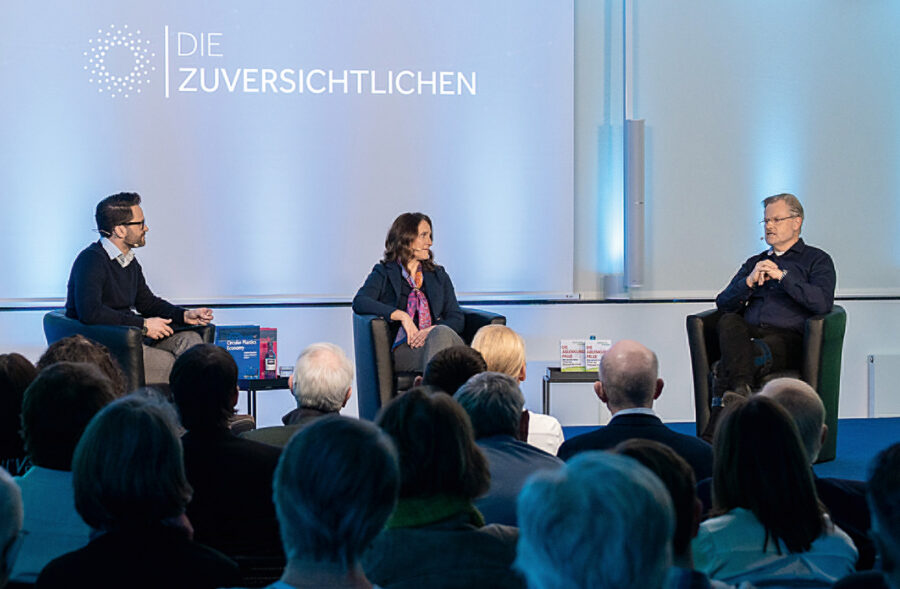
With our talk show format Die Zuversichtlichen, we provide a platform for different perspectives on the major questions of our time—including the connection between the circular economy and resource independence. We reach a broad audience with the live streaming of our talks and help to make these topics the subject of social and economic debate.
An impressive example is the talk that took place between Prof. Dr. Andrea Büttner, managing director of the Fraunhofer Institute IVV, and Reinhard Schneider, owner of Werner & Mertz. They took up the question of how we can escape dependence on fossil-based raw materials and which effects that dependence has today.
It was made clear that subjects such as supply reliability and stable supply chains are inseparably connected to the way we conduct business and use resources. To put it another way: How resilient is a system whose supermarket shelves depend on finite resources?
Circular economy not just a “green” issue
The talk showed that the circular economy is much more than a “green” environmental issue. It is a central strategic response to the challenges of our time in matters of economic stability, social resilience and national security.
The subject came up again in a special edition of Die Zuversichtlichen, which we aired in cooperation with the German Council on Foreign Relations (DGAP). The conversation involving politician and security expert Roderich Kiesewetter, Dr. Kira Vinke and Reinhard Schneider revealed how closely our economic stability, our ability to act and the security of Germany and Europe are connected to the handling of resources.
Dr. Vinke described the situation: “We are entering a new phase of impending consequences from fossil fuels, on which we are highly dependent.” Then she added: “What we should learn from the crisis is to make ourselves independent.” It is not an issue of climate protection alone, but a sovereignty project too.
Invulnerable to blackmail
Reinhard Schneider summed it up: “The best way to avoid conflict lies in not being vulnerable to blackmail.“ What that takes is diversified supply chains, resilient infrastructures and increased value creation with raw materials in one’s own country—ideally in a functioning circular economy.
It’s clear that the circular economy is so much more than an ecological concept. It is a core building block for economic stability, social resilience and political independence.